
Botox vs. Dysport: What's the Difference and Which Is Right for You?
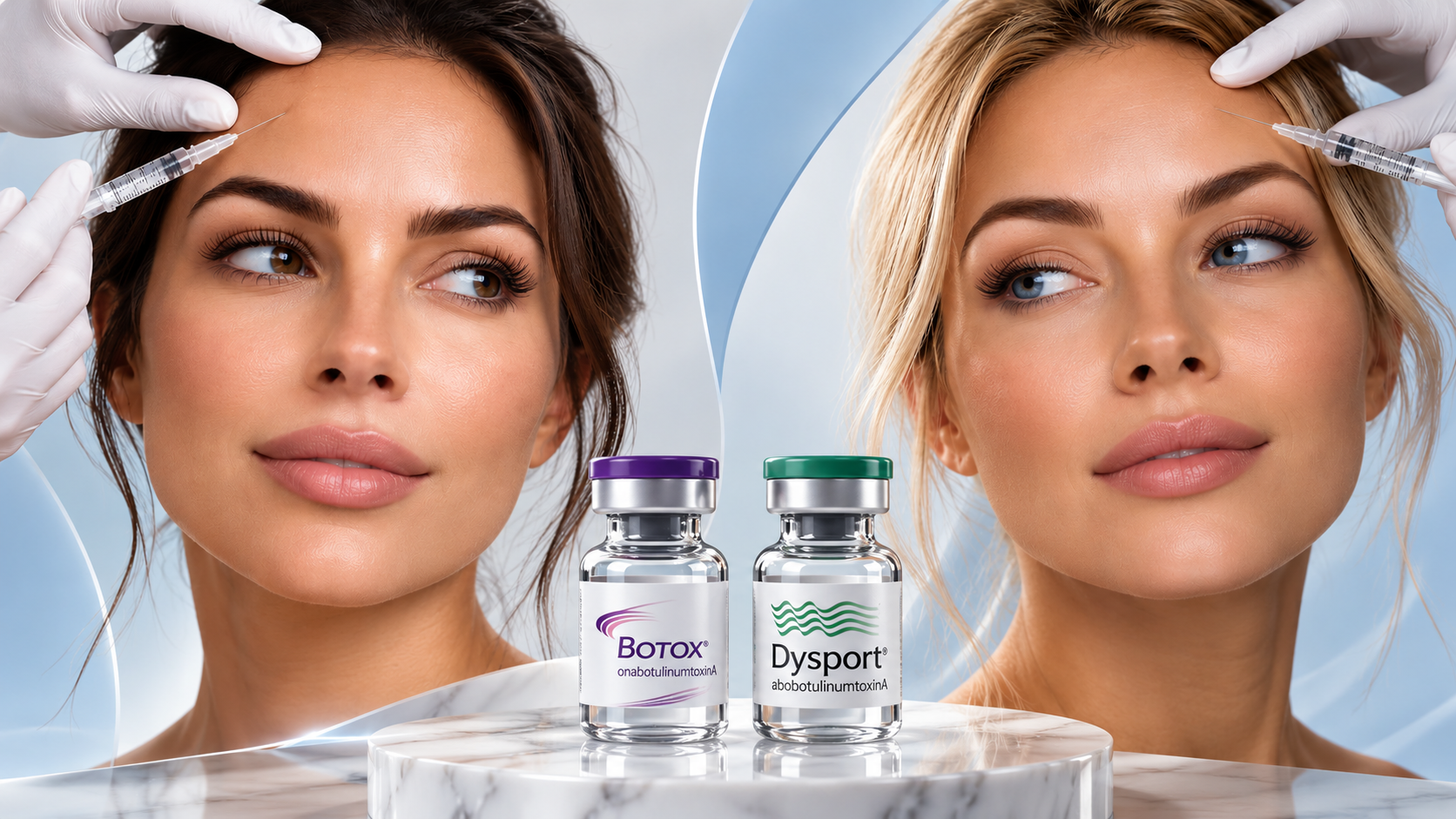
Botox & Dysport What Is The Differences?
Botox vs. Dysport: What's the Difference and Which Is Right for You?
When it comes to softening fine lines and expression wrinkles, Botox and Dysport are two of the most recognized injectable treatments. But while they are often discussed interchangeably, there are important differences in their formulations, dosing, and clinical applications.
At Euphoria Medspa & Wellness in Rancho Cucamonga, we believe patients should understand the science behind their treatments not simply choose a product based on popularity.
The most important question isn't necessarily which neurotoxin is better. It's which treatment is best suited to your facial anatomy, muscle activity, and long-term aesthetic goals.
1. Botox vs. Dysport: Understanding the Science
Both Botox (onabotulinumtoxinA) and Dysport (abobotulinumtoxinA) are FDA-approved neuromodulators derived from botulinum toxin type A.
They work by temporarily interrupting communication between motor nerves and targeted muscles.
Normally, when a nerve signals a muscle to contract, it releases a neurotransmitter called acetylcholine. This chemical messenger activates the muscle, producing facial expressions such as frowning, squinting, and raising the eyebrows.
Botox and Dysport inhibit acetylcholine release by cleaving a protein called SNAP-25, which is essential for neurotransmitter release.
The result is a temporary reduction in muscle contraction, allowing dynamic wrinkles to soften.
But here's what many patients don't realize:
Botox and Dysport don't directly stimulate collagen production, tighten loose skin, or replace lost facial volume.
Their primary function is to reduce muscle activity contributing to expression lines.
Understanding this distinction is important because facial aging involves more than wrinkles. Changes in collagen, skin elasticity, facial fat, and underlying bone structure also contribute to how the face ages.
This is why a comprehensive facial assessment matters.
2. What Is the Difference Between Botox and Dysport?
Although both products use botulinum toxin type A, they have different manufacturing processes, formulations, and dosing systems.
Botox
Botox contains onabotulinumtoxinA and is manufactured by Allergan Aesthetics. It has a long history of clinical use and is FDA-approved for several cosmetic treatment areas, including glabellar lines, crow's feet, forehead lines, and platysma bands.
Dysport
Dysport contains abobotulinumtoxinA and is manufactured by Ipsen, with aesthetic marketing in the United States by Galderma. Its FDA-approved aesthetic indication is the temporary improvement of moderate to severe glabellar lines, commonly known as the vertical lines between the eyebrows.
Both can provide natural looking results when appropriately administered.
The differences become more relevant when evaluating dosing, treatment goals, and individual response.
3. Does Dysport Work Faster Than Botox?
One of the most frequently discussed differences between Botox and Dysport is how quickly results become visible.
Some patients report noticing Dysport results within approximately two to three days, while Botox results may begin appearing within several days.
However, onset varies considerably between individuals, and the evidence does not establish that Dysport consistently works faster for every patient.
Typical treatment timeline:
Botox:
Initial visible effects Often 2–5 days
Typical duration: 3–4 months
Results continue developing: Up to 14 days.
Dysport:
Initial visible effects: Often 2–3 days
Typical duration: 3–4 months
Results continue developing: Up to 14 days
These are approximate clinical expectations, not guarantees. Individual response, treatment area, and dose influence results.
We generally recommend allowing approximately two weeks before evaluating the full cosmetic outcome.
4. Which Lasts Longer: Botox or Dysport?
Both Botox and Dysport generally provide results lasting approximately three to four months, although some individuals experience shorter or longer durations.
Longevity depends on several factors:
Strength and activity of the treated muscles
Dose administered
Individual response to the neurotoxin
Treatment area and injection technique
Previous treatment history
There is no strong clinical evidence demonstrating that either Botox or Dysport consistently lasts longer for all patients when used appropriately.
It's also important to understand that more units do not automatically mean better or longer lasting results.
Appropriate dosing should balance effectiveness with preservation of natural facial movement.
5. Are Botox and Dysport Units the Same?
No. This is one of the most important distinctions patients should understand.
Botox and Dysport use different, product specific potency measurements. Their units are not interchangeable.
In aesthetic practice, Dysport is often administered at a higher numerical unit count than Botox for comparable treatment goals.
For example, a clinician may use approximately 2 to 3 Dysport units for every Botox unit in certain applications.
However, this is a general clinical dosing convention not an officially established conversion ratio or a substitute for individualized dosing.
More Dysport units does not mean Dysport is weaker or that you're receiving more toxin in a directly comparable sense.
Because the products have different potency assays, comparing unit numbers alone can be misleading.
The correct dose depends on the product, anatomy, indication, and treatment plan.
6. Which Looks More Natural: Botox or Dysport?
One of the biggest misconceptions surrounding neurotoxins is that one brand creates a more natural result than another.
In reality, natural looking outcomes depend heavily on the injector's understanding of facial anatomy, muscle function, dosing, and injection placement.
Your facial muscles don't work independently. They function as an interconnected system that influences eyebrow position, eye shape, facial symmetry, and expression.
For example, the frontalis muscle elevates the eyebrows, while other muscles contribute to pulling them downward.
Excessively relaxing the frontalis without accounting for this relationship can create unwanted eyebrow heaviness.
Similarly, inappropriate dosing or placement around the glabella may alter eyebrow position or contribute to eyelid drooping.
The goal should not be to completely eliminate movement.
The goal is to soften unwanted lines while maintaining facial balance and natural expression.
At Euphoria, our approach emphasizes personalized dosing and an understanding of how each patient's facial muscles function together.
7. Is Dysport Better for the Forehead?
You may have heard that Dysport is better for larger areas because it spreads farther than Botox.
However, this claim is frequently oversimplified.
The distribution of a neurotoxin depends on several factors, including:
Total dose
Injection volume and concentration
Injection depth and placement
Individual muscle anatomy
Product specific characteristics
Evidence does not consistently demonstrate that Dysport has greater clinical diffusion than Botox under comparable conditions.
While experienced injectors may have individual preferences for certain products, treatment selection should be based on clinical judgment rather than generalized claims about product spread.
Additionally, Dysport treatment of forehead lines is considered off-label in the United States.
8. What About Xeomin, Jeuveau, and Daxxify?
Botox and Dysport aren't the only FDA-approved botulinum toxin type A products used in aesthetic medicine.
Other options include:
Xeomin (incobotulinumtoxinA)
Xeomin is manufactured without the accessory complexing proteins present in some other botulinum toxin formulations. Like other neuromodulators, it temporarily reduces targeted muscle activity. It is known as the “naked tox”. Xeomin is one of our favorite neuromodulators because it has excellent results and patient’s feel natural.
Jeuveau (prabotulinumtoxinA-xvfs)
Jeuveau is an FDA approved neuromodulator used for the temporary improvement of moderate to severe glabellar lines in adults.
Daxxify (daxibotulinumtoxinA-lanm)
Daxxify uses a peptide based formulation and has demonstrated a longer median duration of effect in clinical trials for glabellar lines compared with the typical duration associated with conventional neurotoxins. Individual results vary.
These products have different formulations and clinical data, and their units should not be considered interchangeable.
Rather than assuming one neurotoxin is universally superior, treatment selection should account for your anatomy, previous results, aesthetic preferences, and medical history.
9. Can Botox and Dysport Prevent Wrinkles?
Neuromodulators are often discussed as preventative treatments because reducing repetitive muscle contractions may help limit the formation or deepening of certain expression lines.
Dynamic wrinkles appear with facial movement. Over time, some of these lines may become visible even when the face is at rest.
By reducing repeated muscle contraction, Botox or Dysport may help minimize the mechanical forces contributing to these changes.
However, neither product stops the biological aging process.
Skin aging also involves:
Changes in collagen and elastin
Ultraviolet exposure and accumulated photodamage
Changes in skin hydration and barrier function
Hormonal changes
Facial fat redistribution and bone remodeling
This is why neurotoxins are only one component of a comprehensive facial rejuvenation strategy.
Depending on your concerns, treatments that address skin texture, collagen remodeling, or volume loss may also be appropriate.
At Euphoria, we may discuss complementary options such as RF microneedling, EMFACE, or biostimulatory injectables when clinically appropriate.
These treatments address different aspects of facial aging and are not substitutes for neurotoxins.
10. Are Botox and Dysport Safe?
Both Botox and Dysport have established safety profiles when used appropriately by qualified healthcare professionals.
However, they are prescription medications and carry potential risks.
Common temporary reactions may include injection-site discomfort, bruising, swelling, or headache.
Less common complications include eyelid or eyebrow drooping and unwanted changes in muscle function.
Both products also carry an FDA boxed warning regarding the potential distant spread of toxin effects, which can cause serious symptoms such as difficulty swallowing, speaking, or breathing.
Patients should disclose their medical history, medications, previous toxin treatments, neuromuscular conditions, and whether they are pregnant or breastfeeding before treatment.
Treatment during pregnancy or breastfeeding is generally avoided because adequate safety data are unavailable.
A thorough medical assessment is an essential part of responsible injectable care.
11. Which Neurotoxin Is Right for You?
There is no universal winner in the Botox vs. Dysport comparison.
Both can be effective for reducing dynamic facial wrinkles, and the best choice depends on the individual patient.
At Euphoria Medspa & Wellness, we evaluate more than the wrinkle itself.
We consider muscle strength, facial symmetry, existing skin quality, previous injectable treatments, and the patient's desired degree of movement.
Under the medical direction of Dr. Patricia Guevara-Channell, who has more than 20 years of experience in aesthetic injectables, our approach prioritizes individualized treatment planning, facial balance, and patient education.
Our philosophy is simple:
The best injectable treatment isn't the one that uses the most units or creates the least movement. It's the one that respects your anatomy and supports a natural, balanced result.
Frequently Asked Questions About Botox and Dysport
Is Dysport cheaper than Botox?
Dysport may have a lower advertised price per unit, but more Dysport units are typically required for comparable treatment goals. Comparing total treatment costs is more meaningful than comparing unit prices.
Can I switch from Botox to Dysport?
Yes. Many patients can switch between products under the guidance of a qualified healthcare professional. Your provider should review your previous dosing, response, treatment dates, and medical history before recommending a change.
Can Botox and Dysport be used during the same appointment?
Different neurotoxins may sometimes be used in a broader individualized treatment plan, but combining products requires careful consideration of dosing, treatment areas, and cumulative effects. It is not routinely necessary.
Does Dysport make your face look frozen?
Neither Botox nor Dysport inherently produces a frozen appearance. Excessive muscle relaxation can occur with either product depending on dose, placement, and individual response.
How often should I get Botox or Dysport?
Many patients schedule treatments approximately every three to four months, depending on clinical response. Retreatment should follow product-specific prescribing guidance and individualized medical assessment.
Which is better for first time patients?
Both may be appropriate depending on the treatment area and medical assessment. For first-time patients, conservative dosing and careful evaluation of facial muscle movement are often more important than brand selection.
Botox and Dysport in Rancho Cucamonga, CA
If you're considering Botox, Dysport, or another neuromodulator, choosing an experienced medical aesthetics provider is an important part of achieving safe, personalized results.
At Euphoria Medspa & Wellness in Rancho Cucamonga, we combine medical expertise with an individualized approach to facial aesthetics.
Whether your goal is to soften existing expression lines, maintain natural movement, or develop a comprehensive facial rejuvenation plan, our team can help you understand your options.
Schedule your personalized injectable consultation at Euphoria Medspa & Wellness in Rancho Cucamonga, California.
This article is for educational purposes only and does not replace individualized medical advice. Treatment recommendations, FDA-approved indications, risks, and expected results vary by product and patient.
Written by: Angela Channell, Wellness Director
Medically reviewed by: Dr. Patricia Guevara-Channell, Medical Director
Scientific & Clinical References
AbbVie Inc. (n.d.). BOTOX Cosmetic (onabotulinumtoxinA) prescribing information. https://www.rxabbvie.com/pdf/botox-cosmetic_pi.pdf
Brin, M. F., James, C., & Maltman, J. (2014). Botulinum toxin type A products are not interchangeable: A review of the evidence. Biologics: Targets and Therapy, 8, 227–241. https://doi.org/10.2147/BTT.S65603
Maas, C., Kane, M. A. C., Bucay, V. W., Allen, S., Applebaum, D. J., Baumann, L., Cox, S. E., Few, J. W., Joseph, J. H., Lorenc, Z. P., Moradi, A., Nestor, M. S., Schlessinger, J., Wortzman, M., Lawrence, I., Lin, X., & Nelson, D. (2012). Current aesthetic use of abobotulinumtoxinA in clinical practice: An evidence-based consensus review. Aesthetic Surgery Journal, 32(1_suppl), 8S–29S. https://doi.org/10.1177/1090820X12455192
Sundaram, H., Signorini, M., Liew, S., Trindade de Almeida, A. R., Wu, Y., Braz, A. V., Fagien, S., Goodman, G. J., Monheit, G., & Raspaldo, H. (2016). Global aesthetics consensus: Botulinum toxin type A—Evidence-based review, emerging concepts, and consensus recommendations for aesthetic use, including updates on complications. Plastic and Reconstructive Surgery, 137(3), 518e–529e. https://doi.org/10.1097/01.prs.0000475758.63709.23
