
Why Tendon Pain Won’t Go Away: Understanding Chronic Tendinopathy & Modern Treatment Options
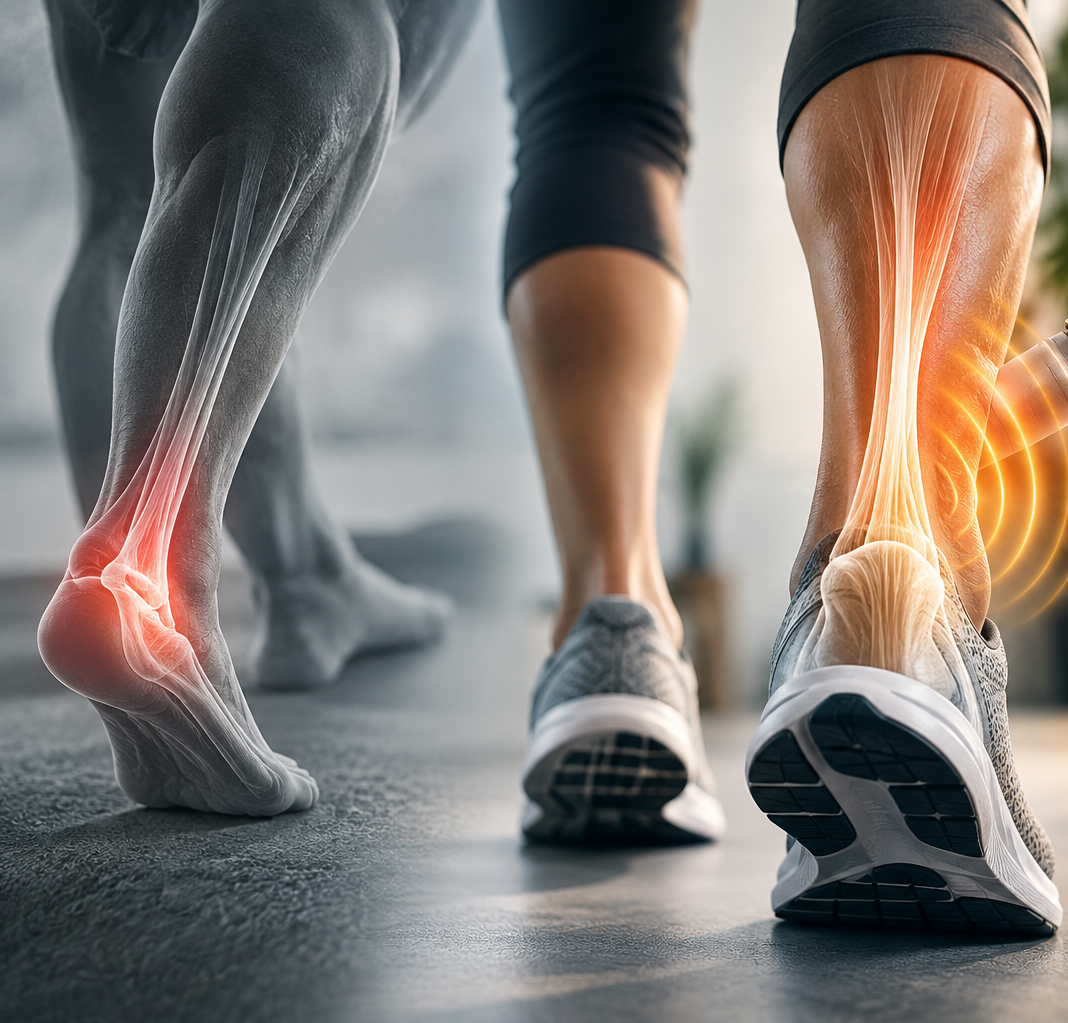
Tendon pain can be frustrating especially when you’ve rested, stretched, modified your workouts, or used anti-inflammatory medication only to have the pain return when you become active again.
One reason is that persistent tendon pain isn’t always simply an inflammation problem. Modern tendinopathy research describes a more complex process involving changes in tendon structure, function, pain, and the tissue’s ability to adapt to mechanical load.¹˒²
Understanding that difference can change how persistent tendon problems are approached.
Acute Injury vs. Chronic Tendinopathy
An acute injury typically occurs suddenly, and inflammation can be part of the body's normal response to tissue injury.
Tendinopathy is more complex. One influential model describes tendon pathology along a continuum—from reactive changes through tendon disrepair and, in some cases, degenerative changes. Importantly, researchers also emphasize that tendon structure, pain, and function do not always correlate perfectly, which is one reason treatment needs to consider more than imaging or pain alone.¹˒²
Tendon-related problems commonly affect areas such as the Achilles tendon, patellar tendon, elbow, shoulder, hip, and plantar fascia.
This can create a familiar cycle:
Pain develops → activity decreases → symptoms improve → activity resumes → pain returns.
Why Rest Alone May Not Solve Tendon Pain
Tendons are designed to tolerate mechanical load.
While temporarily modifying activity can be appropriate, rehabilitation for conditions such as Achilles tendinopathy commonly incorporates progressive tendon-loading exercise rather than relying on complete rest alone. Current clinical practice guidelines emphasize individualized assessment and evidence-based physical therapy interventions for Achilles tendinopathy.³
Depending on the diagnosis, a recovery strategy may incorporate progressive strengthening, mobility work, modification of aggravating activities, and gradual return to activity.
The goal isn't simply to reduce discomfort.
The goal is to progressively restore the body's ability to tolerate the activities you want to perform.
Why Can Tendon Recovery Take So Long?
Tendon pain is not determined by tissue structure alone.
Research has demonstrated a complex relationship between pain, tendon structure, and function, which helps explain why symptoms and structural changes don't necessarily improve at exactly the same rate.²
This is one reason simply waiting until an area feels better and immediately returning to the same training demands may not address the entire problem.
A comprehensive strategy should consider not only where it hurts, but also the activity demands being placed on the tissue and the patient's current functional capacity.
Where Does Focused Shockwave Therapy Fit In?
For certain chronic tendon and musculoskeletal conditions, extracorporeal shockwave therapy (ESWT) may be incorporated into treatment.
Shockwave therapy delivers acoustic energy to targeted tissues. International recommendations recognize ESWT for several chronic tendinopathies, including Achilles tendinopathy, patellar tendinopathy, lateral epicondylopathy (tennis elbow), calcific shoulder tendinopathy, greater trochanteric pain syndrome, and plantar fasciitis.⁴
More recent international sports-medicine consensus work has also developed recommendations regarding ESWT terminology, clinical indications, procedural considerations, contraindications, and potential side effects.⁵
At Euphoria Medspa & Wellness, focused shockwave may be considered for appropriately selected patients experiencing persistent musculoskeletal or tendon-related concerns.
Learn More About Focused Shockwave Therapy
Focused Shockwave Therapy in Rancho Cucamonga →
LINK THIS TEXT TO YOUR SHOCKWAVE SERVICE PAGE.
Focused Shockwave vs. Radial Pressure Wave: What's the Difference?
Not every device marketed as “shockwave” delivers energy in the same way.
Focused shockwave technology can deliver energy to a defined treatment depth, while radial pressure-wave technology produces a different pattern of energy distribution. Treatment depth is an important consideration when selecting technology for different tissues; the International Society for Medical Shockwave Treatment specifically notes the importance of considering penetration depth when treating deeper structures.⁴
That distinction is one reason patients should look beyond the word “shockwave” and understand what technology is actually being used.
Shockwave Therapy Isn't a Replacement for Rehabilitation
Technology alone cannot address every factor contributing to a persistent injury.
Strength, mobility, biomechanics, training volume, recovery, and the amount of load placed on the affected tissue may all need to be considered.
For this reason, shockwave therapy should be viewed as a potential component of an individualized treatment strategy, rather than a universal solution for every type of pain.
At Euphoria, we look at recovery through a broader performance and wellness lens.
Reducing symptoms matters—but so does helping patients restore function, tolerate activity, and return to the things they want to do.
Why Proper Evaluation Matters
Heel pain isn't automatically plantar fasciitis.
Knee pain isn't automatically patellar tendinopathy.
Shoulder pain isn't always a rotator cuff tendon problem.
Different conditions can produce similar symptoms, and even within tendinopathy, pain and structural findings don't always have a straightforward relationship.²
Before deciding whether focused shockwave therapy is appropriate, evaluation should consider the location and duration of symptoms, aggravating activities, previous injuries and treatments, current physical demands, and whether the suspected tissue is an appropriate target for treatment.
At Euphoria, our philosophy is simple:
Technology works best when it's used for the right patient, right tissue, and right reason.
When Should Persistent Tendon Pain Be Evaluated?
If pain repeatedly returns when you exercise, limits your normal activities, or hasn't improved despite appropriate conservative care, further evaluation may help identify contributing factors and guide treatment.
Instead of repeatedly cycling between pain → rest → temporary improvement → pain again, the goal is to understand what you're dealing with and develop an appropriate strategy for restoring function.
Euphoria Medspa offers Focused Shockwave Therapy in Rancho Cucamonga as part of our integrative approach to recovery, performance, and wellness.
Ready to Find Out if Focused Shockwave Therapy Is Right for You?
Schedule a consultation with Euphoria Medspa to determine whether focused shockwave therapy may be appropriate for your specific concern.
Scientific References
Cook, J. L., & Purdam, C. R. (2009). Is tendon pathology a continuum? A pathology model to explain the clinical presentation of load-induced tendinopathy. British Journal of Sports Medicine, 43(6), 409–416. https://pubmed.ncbi.nlm.nih.gov/18812414/
Cook, J. L., Rio, E., Purdam, C. R., & Docking, S. I. (2016). Revisiting the continuum model of tendon pathology: What is its merit in clinical practice and research? British Journal of Sports Medicine, 50(19), 1187–1191. https://pubmed.ncbi.nlm.nih.gov/27127294/
Chimenti, R. L., Neville, C., Houck, J., et al. (2024). Achilles pain, stiffness, and muscle power deficits: Midportion Achilles tendinopathy revision 2024. Journal of Orthopaedic & Sports Physical Therapy, 54(12), CPG1–CPG32. https://pubmed.ncbi.nlm.nih.gov/39611662/
International Society for Medical Shockwave Treatment. (n.d.). ISMST recommendations: Consensus statement on ESWT indications and contraindications. https://shockwavetherapy.org/ismst-recommendations/
Rhim, H. C., Singh, M., Maffulli, N., et al. (2025). Recommendations for use of extracorporeal shockwave therapy in sports medicine: An international modified Delphi study. British Journal of Sports Medicine, 59(18), 1287–1301. https://pubmed.ncbi.nlm.nih.gov/40032293/
